

Stablecoins 101
Explaining Stablecoins in plain English

In my last piece, I talked about the growing momentum behind Stablecoins. Now that we’ve established the “why,” I want to take a step back this week and offer a primer to help demystify what Stablecoins actually are. The word itself sounds cryptic, and honestly, I’m learning too, so this breakdown is as much for me as it is for you.
The aim of this rather short article is to equip you with the basics.
What are Stablecoins?
Stablecoins are digital currencies that live on blockchains, but unlike Bitcoin or Ethereum, their value is meant to stay stable.
Most are pegged 1:1 to the U.S. dollar or other real-world assets. That means one USDC (a popular Stablecoin) is meant to always be worth one dollar.
Why does that matter?
Because it gives you the speed, global access, and programmability of crypto, without the volatility.
Two core functions:
Stablecoins serve two basic but powerful functions in the digital economy:
Medium of Exchange: They can be used to pay for things - instantly, globally, and often for fractions of a penny in fees.
Store of Value: In countries where inflation erodes purchasing power overnight, Stablecoins offer an off-ramp. Holding digital dollars can be safer than the local currency.
That’s why they’ve seen explosive adoption in places like Argentina, Turkey, Nigeria, and Lebanon. Stablecoins offer something banks, local governments, and even PayPal can’t always guarantee: accessible, reliable value.
How are Stablecoins faster than traditional payments?
Because they bypass the traditional financial system.
When you use Venmo, credit card or even your pay by bank, the transaction has to go through multiple intermediaries: banks, payment processors, clearinghouses. That introduces delays, fees, and time zone headaches.
Stablecoins run on blockchains like Ethereum or Solana, which are decentralized networks where transactions settle in near-real time, essentially no banks, no middlemen, no “business hours.”
And that opens the door to new possibilities.
What makes Stablecoins different: Programmability
Stablecoins aren’t just faster, they’re programmable. That means developers can build logic into them. For example:
Automatically split a payment between a supplier, shipper, and retailer.
Set up streaming payments that release funds every minute.
Freeze or redirect a token if fraud is detected.
In short, Stablecoins act like digital Lego blocks for money. You can build apps on top of them, automate complex processes, and remove the need for manual approvals.
Okay, So how are they issued?
Let’s take USDC, issued by Circle, as an example.
You send $100 to Circle.
Circle mints 100 USDC tokens and sends them to your crypto wallet.
That $100 sits in Circle’s reserve, usually held in U.S. Treasuries or bank accounts.
If you want to cash out, you send the USDC back to Circle, and they give you back $100 and the tokens are destroyed.
No actual money moves when you send Stablecoins from one person to another , it’s just the claim to the money moving. Think of it like passing around poker chips that are backed by real cash at the cashier.
Types of Stablecoins:
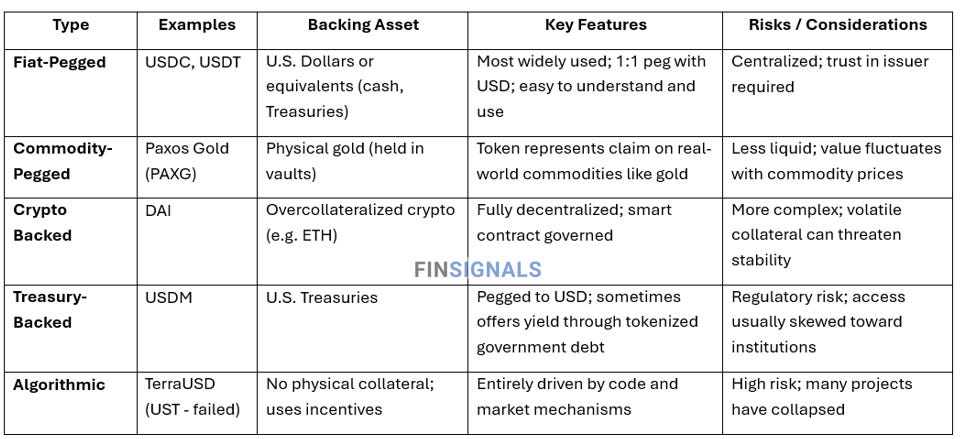
Stablecoins are typically divided based on what backs or stabilizes their value. This backing determines how the Stablecoin maintains its peg (usually to a fiat currency like the USD) and how much risk or decentralization is involved. The table below covers different Stablecoins:
How Stablecoins compares to Venmo, Credit cards or Bank transfers?
With apps like Venmo or Zelle, you're using a closed-loop system that sits on top of traditional banking rails. It works well within the U.S., but it's limited by geography, business hours, and the need for both sender and recipient to be inside the same ecosystem.
With credit cards, transactions are fast at checkout but rely on a complex network of banks, processors, and card networks. Settlement takes days, and merchants pay 2–3% in interchange fees — which often get passed on to consumers.
With stablecoins, transfers happen directly on-chain via public blockchains like Ethereum or Solana. They’re borderless, available 24/7, and settle nearly instantly with minimal fees and no intermediaries.
How Will End Users Interact With Stablecoins?
Today:
Remittances: Send USDC to family abroad in seconds, without fees or delays.
Payroll: Freelancers or contractors get paid in stablecoins, especially in emerging markets.
Trading: Stablecoins serve as the base currency for crypto trading.
Saving: In high-inflation countries, people save in USDC to preserve value.
Tomorrow:
Embedded in wallets (like PayPal, Coinbase, or MetaMask)
Integrated into checkout flows (buy with Stablecoins online)
Used for in-game purchases, creator payments, subscription services
Programmable auto-payments and smart contracts replacing invoices
I hope this helped you with the basics, in the further articles, I will expand on why banks and retailers are scrambling to issue Stablecoins.